Sunday, February 16, 2014

The Learning Curve: Adventures in Self-Directed Education

Back when I started this blog, I promised several recurring features that I haven’t always delivered on.  (I like to think that if you take the long view, all of my promises will be kept...it’s all a work in progress!)

One of those features was discussion of self-directed continuing education, with my own experiences with setting up curricula for myself as the model.  Of course, the main reason you haven’t seen much of that is because I haven’t done a great job creating and sticking to my own curricula.  Well, January started a new semester, and I’ve been much more successful so far.  Various web-based options are making it easier to keep up one’s education outside of the traditional bounds of the classroom, and I’m interested to hear from my readers about their own experiences or with commentary on my choices.

First off, I decided that continuing library/info studies education doesn’t necessarily have to include the stuff you might expect to find in your official program--on the contrary, there are lots of subjects that are of immediate benefit to the librarian but which don’t fit into our 2-ish years of training.  For me, top on that list is Spanish.

I’m interested in working in large urban public libraries, and nearly every job posting I’ve responded to has listed proficiency in Spanish as a preferred qualification, if not an outright requirement.  Well, this guy made the very positive, yet not so demographically savvy, decision to study French starting in middle school, going on to major in the language in college.  While I very much enjoyed learning to read and discuss Hugo and Sartre in their original tongue, it hasn’t lended itself to employers snapping me up.

Spanish, I recognize, is extremely valuable to know in the American workforce today.  It’s the most-spoken non-English language in American homes, and overall there are 69 million hispanophones in the US.  While a great many of them also speak English fluently or very well, there’s a sizable number who do not--and besides, sometimes it’s more comfortable for people to conduct business in their native language, no matter how well they speak another.  

In the little community public library where I volunteer, a good proportion of the patrons I encounter every day are Spanish-speakers.  I decided it was time I had the ability to at least offer the option of communicating in these folks’ first language.  While it will be many years before I’m able to do so in a way that won’t make them cringe at my vocabulary and accent, I can at least get the process started with increasingly useful, rigorous and affordable online language-learning options.  

For this effort I’ve chosen Duolingo, with which I previously had a positive experience practicing Portuguese just for fun.  It’s a colorful site that offers an intuitive scaffold of each language to climb toward proficiency, breaking it down into digestible, thematic chunks--sometimes grammatically like pronouns, sometimes by subject matter like food.
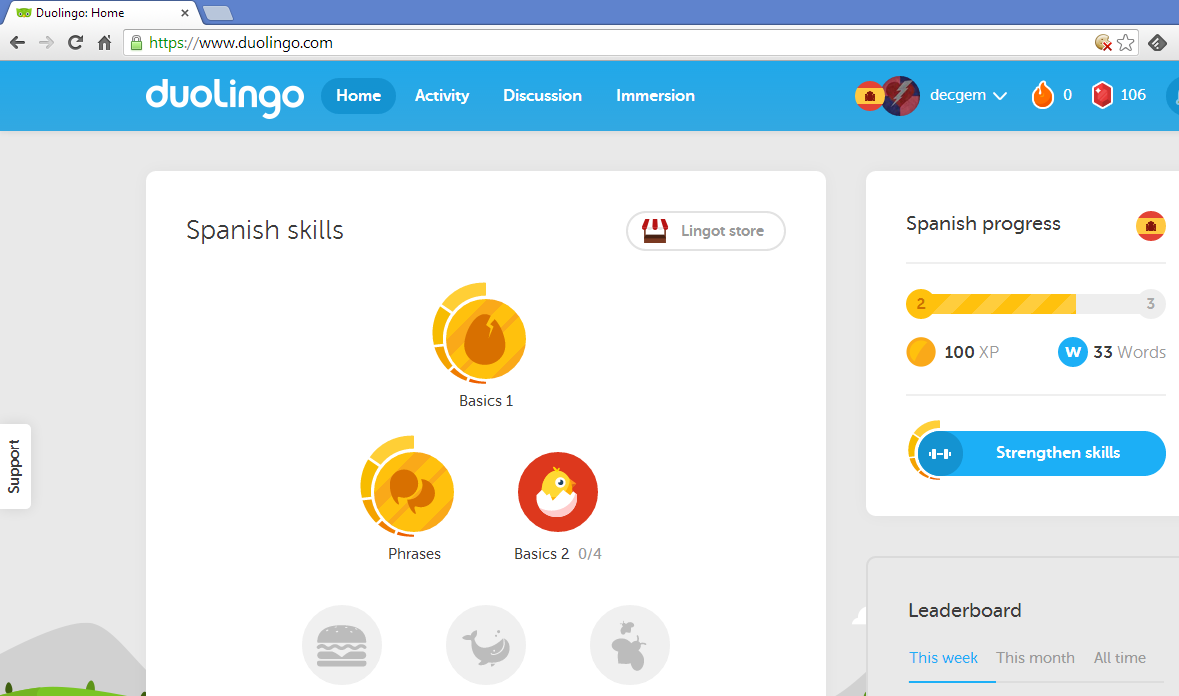


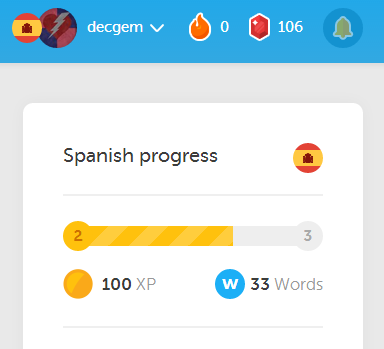
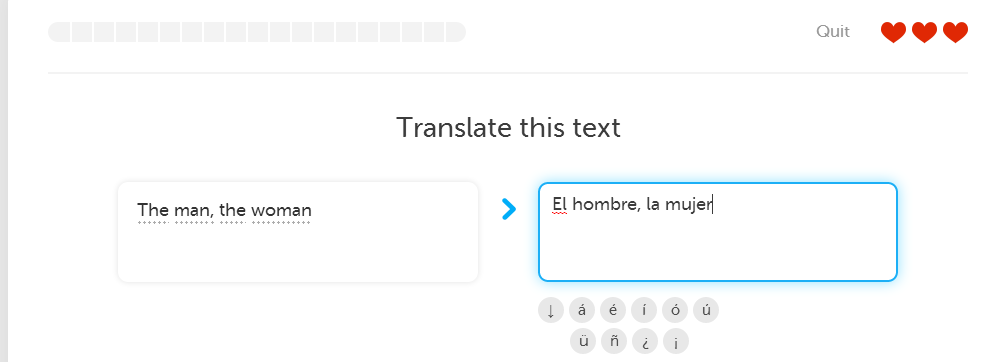
The experience is nicely gamified to grab and hold attention: you earn points for successful lessons completed and which you can compare with those of your friends, and you earn bonuses for streaks of days practiced.  During lessons, you have three hearts--make too many mistakes and lose all your hearts, and you have to restart in that area.  But success also earns you some web-currency, ‘lingots,’ which you can use to purchase bonuses and upgrades, like extra hearts.


One feature I didn’t grasp at first, but which is actually really helpful, is aimed at combating recall decay.  When you complete a lesson, you have four full bars in the skill it covers--a happy little fully-charged feeling.  But as time goes by, you lose bars, and you have to go back and practice that skill to build bars back up.  It’s a great visual cue to remind you to go back and really lock down that content, rather than washing your hands of it.


The goal of Duolingo is to crowdsource translations of web-based content.  The thought is that there are too many millions of gigabytes of content building up through such outlets as  BuzzFeed for it ever to be translated in-house for global access.  By teaching people some of the top world languages, Duolingo hopes to harness their new skill to fill that gap.  Every now and then a dialog box pops up saying “You can now translate x% of all listicles!  Why don’t you give it a try!”

Frankly, I’m dubious.  It’s a noble aim and I will certainly do my part if I feel like I know enough to contribute competently, but even after months of practicing Portuguese, I wasn’t confident tackling BuzzFeed translations.  Especially not given the slang-heavy nature of most Web writing--Duolingo focuses on official language, so I’m really not sure how successful I’ll ever be in this part of the operation.  But I applaud those who make it work.
If you’re in the mood to pick up a new language, need a crash-course for a new life situation, or want to brush up on an old favorite, Duolingo is a great option.  And did I mention it’s free?  Money talks (several languages).  And if you already have a background in a given language, you can test out of the basic lessons and dig right into the  pollo y manzanas (chicken and apples--as close as I can get to ‘meat and potatoes’ so far!).  Eventually I will branch out from Duolingo and enlist some Hispanophone friends to converse with me and share more advanced, library-specific vocabulary...but for now I have to get my conjugations down.


So that’s my first self-directed course of study in my own private spring semester.  Tune in soon when I let you in on my efforts exploring coding and gamification, and chime in with your thoughts and feelings in the comments!

Sunday, February 9, 2014

Media Binges: The Good, the Bad, and the Library

We live in an era of a new media consumption model--the binge.  

We stream whole seasons in a day and knock off DVD box sets in a week.  DVRs and On-Demand services allow us to enjoy marathons of our current programming without (as many) ads or those pesky week-long waits between plot points.  Spotify and iTunes playlists deliver our music to us in a neverending cycle.  

And librarians are particularly responsible for making even books into objects of mass consumption--what else would you call our insistence that we cram as much reading as physically possible into each year? It’s bingeing at a slightly slower frame rate.

So what to make of this burgeoning trend?  Is this a positive development, a negative one, or in between?  And what role should libraries play in supporting or combating it?

I, for one, am excited about libraries’ ability to promote media-gulping.  For one thing, since it’s what people are doing anyway, it’s great that libraries are already equipped to mesh with their behavior; many of us have got respectable runs of popular TV shows on DVD, ready for plowing through, and we already do a brisk business in DVD lending.  Why pay for Netflix?  (And if you want Netflix too, maybe your local library can help fill some of its frustrating online gaps.)

Beyond that, though, I think that media bingeing is actually a positive development, and librarians are in place to mainstream it and its benefits.  My experience with reading, in particular, shows me that the longer a process is strung out, the more comprehension and command of detail suffers.

In an environment where even the most accessible of TV dramas operates on a serialized basis, and where your TV sitcom favorites undergo actual character growth and change across a season, watching TV is more like reading a novel than ever.  That’s a good thing, but it doesn’t really work with the traditional broadcast television model.

It’s been opined that Game of Thrones functions better as a season-by-season unit while some individual episodes suffer in isolation. I’ll go out on a limb and suggest the same applies for Breaking Bad, Homeland, Downton Abbey...heck, schlocky Revenge and Scandal are often difficult to keep track of from week to week.

So maybe for some people, it’s optimal to wait for the end of the season or for the DVD release, either for the sake of aesthetic appreciation or for personal viewer comprehension.  And again, who has those DVDs ready for free (and who is hot on the trail of various streaming access options)?  Don’t make me spell it out for you!

So, bingeing is good and libraries promote it--but sensible consumption is a desirable outcome as well.

Sitting in your basement watching all of Breaking Bad is a closed circuit activity unless you internalize lessons learned, share opinions, and rejoin the community with new things to say and new perspectives to offer.  Happily, the Internet provides opportunities for this kind of interaction in droves, and many consumers avail themselves of such things.  But a lot do not.

Librarians have a responsibility to perform, model and instill the habits of conscientious media consumption.  We need to write and post reviews, in our public and private lives both.  We need to call out positive and negative examples of media citizenship--applaud diversity and inclusivity; decry stigma and exclusion.  We must encourage our patrons to be canny consumers--introduce them to Goodreads and Getglue and IMDB message boards.  Inspire them to become critics in their own lives.  

If you want to get really crazy, promote the idea of tracking amounts and types of media consumption--with the goal of demonstrating growth in terms of amounts digested, the complexity of ideas encountered, and the types of genres and media in which fluency has been achieved.  

Why promote all of this?  Because watching TV and movies, reading books, and listening to music doesn’t have to be a totally solipsistic, zero-sum endeavor.  Exposure to ideas and events should change us, and we should be able to recognize how it’s changing us--the better to place ourselves in relation to the world around us.

(Slightly off my desired track, but important to note: the library is a good place to be a media consumer without resorting to thievery  Librarians need to make sure potential patrons know about the damage pirating material does, and not just in a self-interested “Don’t sue me, brah!” way.  Pump up the library as a legit conduit in the media consumption pipeline, much safer and happier for everyone than torrents or Russian link aggregators.)

And at the end of the day, even if we can’t be THE player in binge media consumption, libraries can act as the great leveler--as we so often have.  We can be the solid option for all those who can’t choose to own seven seasons of Lost.  As always, it comes down to social justice, and equal access to entertainment is no less important an issue as access to research materials.

(Truly, say otherwise and I’ll fight you.  Art is the way we know ourselves.)

I’m genuinely amped about librarians’ role in promoting this paradigm, and I hope I’ve been somewhat convincing on the matter.  My fear is that some self-important members of the new crop of information professionals will decide that access to binge-worthy materials isn’t “critical” enough to dedicate resources to.  I hope many will join me in talking up the import of this stuff as librarianship continues to evolve.

Thursday, January 30, 2014

Midwinter Postmortem


Just wanted to do a little post mortem on the rest of my experience at the Midwinter conference in Philadelphia, which I rather criticized in my last post.  Overall, the experience was very positive and helpful, and again, I don’t blame ALA for the problems I pointed out last time.  LGBTQ literature, while important, is still very niche, and it is up to those of us with a stake in the benefits its existence provides to see that our organizations and publications reflect our need.  Onward!

My experience in Philadelphia was very food oriented and very game oriented.  The food part had little to do with actual conference happenings--it was most thanks to the Reading Terminal Market and the very good taste of my local friend Brendan--but I did attend one of those “What’s Cooking at ALA?” sessions on the exhibit hall floor, goofy as such things are, and had a great time.  The one I hit was pizza-based, hosted by pizza expert, tour guide and box art specialist/record holder Scott Wiener, who was very engaging on the subject for ten o’clock in the morning.  He coached the small but enthusiastic crowd on proper pizza technique (I now know how to avoid tip sag) and cooked us up a pie to sample while waiting for him to sign free copies of his book on pizza boxes for us.  I liked his signature line style--he had a ready stream of questions for each of us that ensured non-awkward interaction and gave the impression  of complete personalization.  Mine was “What’s your least favorite pizza topping?” to which I quickly answered “black olives,” so he drew me a black olive with a no-smoking sign through it.  What  a sweetheart.


A more unfortunate floor experience came when I accidentally got a book signed by Cal Thomas before I realized he was an archaeoconservative homophobe.  I would have felt bad snubbing him, though.  (I have to snicker at “the Queen Latifa” and “Ellen Degenerous” though, but seriously, stop shouting in all-caps, Cal!  We can hear you.)

But games!  You know I love games, dear readers, and their potential for library use and enrichment.  I attended two sessions hosted by the GameRT (Game Round Table--there’s a group for every interest at ALA!) in general, one by the Game-Making Interest Group in particular.  Got some great ideas on how to host a board game program at a library, particularly one focused on introducing seniors to “modern” board games.  There’s research to be done here, folks!  Also a great description of a really fun-sounding murder mystery event out near Seattle.  I would love to hold such a thing.  It all goes to show that there’s a world of possibility for the incorporation of existing games and game-like behavior in libraries, and there’s an audience and a purpose for it.

The game-making event was more generally informational, which was great in its own way.  To my pleasant surprise, the best practices that the facilitator mentioned were provided by Mary Broussard, librarian at my alma mater!  She bases her pointers off the success of her anti-plagiarism game.  Very cool to hear about Lycoming College in a non-alumni setting.  The Game-Making IG is in need of more active members; I don’t know, should I volunteer?  (If you’re interested in the best practices, other game making resources, and coding self-help that was mentioned at this session, dear readers, please let a blogger know; otherwise I shan’t trouble you.)

http://www.lycoming.edu/library/instruction/tutorials/plagiarismGame.aspx


The president’s program was also a great time, and got me on to a new-ish organization that I hope to involve myself with at some point.  The Harry Potter Alliance aims to use the power of fiction, and the enthusiasm fiction inspires, to tackle real-world problems.  I’m overjoyed, because I’ve long felt that fandom generates a lot of energy that is--well, I won’t say ‘misdirected,’  because a lot of creative stuff comes out of it, and we don’t have to judge people for simply enjoying anything and never taking it further.  But I will say that with all that energy in the world, it’s good to have an alternate outlet for it towards issues of social justice and need.  The organization’s founder gave a very inspirational speech, if annoyingly read directly from paper (he had been sick and had probably not had enough time to prepare; still, the parts where he went off script, either for humorous or passionate effect, were the most worthwhile parts of his two-hour talk).  I encourage all of you involved in fandom of one ilk or another to check out HPA’s website and think about getting involved, especially as their very grassroots campaigns have begun to branch out from strictly Potterverse flavors.  (What kind of social problems could the Game of Thrones fandom address?  Several funny answers spring to mind, but war refugee relief would be a good, serious one.)

There were a few other bits and pieces, but those were the highlights for me.  All in all this was a lonelier experience for me than ALA Annual was, lacking my buddies Esther, Natalie and Bryan (missed you guys!).  But special thanks to the aforementioned Brendan, as well as Natasha and Alicia, for being stalwart dinner companions and makeshift innkeepers, and to librarians Matt and Cheng, friends who I met up with along the way (sometimes unexpectedly) to make the between-session time pass more pleasantly.

Now, on to Vegas!

Friday, January 24, 2014

ALA Midwinter Update

24 January 2014
Frigid Tundra (Philadelphia)

After an arduous journey by amtrak-coach during which all possible indignities were thoroughly experienced (a seat partner in the last third of the trip!  A power outage-caused hour-plus delay!  Old jerk bonhomie train conversation!  Blatant hat-head!), I made it to New-York City and thence, this morning, to Old Philadelphia, where ALA is holding its midwinter hibernation stretch.  A much-needed Indian supper was had at Reading Terminal Market before I plunged into the conference...

...where the session I was aiming for was canceled, the exhibit floor doesn't open 'til 5:30, and these young librarians playing Librarians Against Humanity don't seem open to outsiders inviting themselves in.

So I made my way down to the ALA store, where, after a few glimpses through some indexes to determine the quality of the publications (thanks, Dr. Nesset!), I noticed something distressing.

Very few of the books published by ALA and available right now have anything to say about the experiences of LGBT patrons and employees.  Indeed, by my best estimate, not a single book available at the ALA store is focused primarily on this demographic.

Now, did I look through the index of every book in the room?  No.  Nor, I'm sure, did I see the title, spine or cover of every available publication.  I very well could have missed something.

And there were a couple of signs of LGBT presence in our professional thought processes.  Two books on kids and young adult services, admirably, possessed some glancing mention of LGBT needs.  So there's that.

But all these things serve to underscore several points that are rather unfortunate:

1.  ALA (and by extension, librarians) are still thinking primarily in terms of LGBT youth when they think about LGBT people at all, ignoring millions of people with critical needs and wants.

2. If there are more books on this subject currently available, the ALA store at this conference did not do a good job featuring them; none of the out-facing books had anything to do with writings on the LGBT experience.

3.  As a publisher, ALA displays a lack of consistency in classifying and indexing LGBT-focused passages, which may have led to my missing any more such passages than I found; in the books that did feature some indexing on the subject, they were indexed under different terms, with less than exhaustive cross referencing in all cases.

4.  Assuming I didn't miss anything due to (2) and (3), few ALA writers are interested in addressing this demographic's service needs in a long-form format.

I point no fingers; a publishing concern can't control the topics submitted by its writers in more than a rudimentary way, and convention staff can't feature products that aren't there.  There could be more control exerted in indexing standards (how hard would it be to adopt a consistent form across ALA publications?), but if there isn't huge interest among the professional body to address these topics in book form, there won't be any published products.

Which means those of us librarians so concerned need to address this lack.

Sunday, January 12, 2014

Boarding Pass: Game of Thrones: The Board Game: Feast for Crows Scenario; or, That's a Lot of Colons

A Game of Thrones: The Board Game: A Feast for Crows
Fantasy Flight Publishing
Expansion design: Jason Walden
Core game design: Christian T. Petersen

Longtime readers of my blog will no doubt remember my longtime overwritten post reviewing the Game of Thrones board game from Fantasy Flight.  As a bit of a coda to that post, I’d like to bring you a much more bite-sized review of the the “Feast for Crows” scenario now available to play with the core game.

What I so enjoy about contemporary board gaming is that it’s not a static pastime--so much of each game evolves.  That’s true of each experience of playing a particular game, since the depth of strategies available make for a different universe of possibility each time you grab your favorite cardboard treasure chest and let the bottom slowly de-vacuum suck from the top and plop with the utmost ceremony onto your playing table.

In the olden days, every game of Monopoly was essentially the same--everyone would try to get Boardwalk, somebody would be stuck with the purple ones, no one would buy the utilities, et cetera.  Not so with these ‘pro’ board games.  Nothing is set in stone with them.

But in addition to all that, the games themselves evolve--as in the constellation of components and rules that make up potential gameplay--through expansions, new editions, and what Fantasy Flight has termed, for this game at least, ‘scenarios.’  With these, you have new options to spice up your enjoyment of the core game, add a little variety to the proceedings.  And for a game based on a property as changing and alive as Game of Thrones is, that’s definitely a welcome opportunity!

FF has released two such scenarios so far, corresponding roughly to the events and circumstances of the most recent books in the series, A Feast for Crows and A Dance with Dragons.  The former, as least, introduces new game concepts that make for an even more authentic Thrones experience of intrigue, back-stabbing and military conquest.

How so?  Well, unlike the basic GoT game, which was a basic territory control game (“first player past a certain threshold wins”), FfC bases its victory condition on the fulfillment of various objectives--each player (or “House”) has a basic objective that they can try to honor every round, plus a hand of randomly-drawn cards offering up additional goals that can be cashed in once and only once.

What’s neat about these cards is that they recognize that the objectives will be easier for some houses than for others, and score you appropriately.  If House Stark is asked to control a territory that’s more or less already in its sphere of influence, it might only get one victory point for that; but if faraway House Baratheon happened to have drawn that card, it might score two or three points for fulfilling its objective.

And since you can never be sure what objective each player has in hand, you can never be quite sure how close to victory anyone is.

This scenario also asks you to swap out the original game’s first “Westeros” deck of round-altering circumstance cards for a new one that plays with the objective mechanic.  Thanks to these new Westeros cards, you might have to swap objectives with another player, have the option of rejecting a too-tenuous objective, and more. The other nice revised rule is that the “supply” mechanic occurs once each round--a process that was subject to random “Westeros” draw in the original version, leading to oversized armies for some and choked-off resources for others.  Now things are much more dynamic, with new armies entering the field every round even as others are forcibly disbanded--but with another supply opportunity coming up every round, no one period is too damning or overpowering.

Perhaps most fun for those of us who love the books and TV show is that the FfC scenario introduces a new faction that was left off the original map: House Arryn.  That means new House cards modeled after the most prominent characters to help you out in combat; their art alone is worth the price of admission, but the way their various special skills shake up the game is not to be sneezed at. Sadly, there is no little Lord Robert making his porridge fly, but one can always hope for the next revision…

To make the game even more thematically appropriate, I did a little experiment and used the House Stark deck from the Dance with Dragons scenario during one FfC game.  It would be too spoilery to get into why the basic deck no longer really works thematically, or whom you can find in the DwD version--but if you’re all caught up with the books you’ll want to try this out.  I didn’t notice the balance to be off at all, and doing it this way will make you feel so much more canon-comfy.

The Feast for Crows scenario is a fun alternative to the basic Game of Thrones game.  It’s designed for four players, so gameplay is faster-paced--perfect if you want a Thrones night but don’t have 8 hours to set aside.  The presence of concrete objectives actually makes for authentic-feeling diplomacy sessions, if that’s the way you play--everyone’s gunning for something, sometimes conflictedly so, and you never know for quite what, so deals get made and broken with much more consequence.  And it’s just fun adding House Arryn to the mix.  If you already own the core board game, this is a must-add.

Excitingly, Fantasy Flight offers this scenario as a print-on-demand commodity, so go get yours now!

Tuesday, December 31, 2013

A Year in Cultural Consumption

My answer to all the year-end lists coming out right now is one of my own, and yet chunky with paragraphing.  Here is my review of one librarian’s year in cultural consumption, encompassing my major food groups of media!


(And remember, like carbs, sugar and fat, TV and movies are not inherently bad for you, and can even be good for you as part of a balanced media diet that includes plenty of fresh books, graphic novels and more.  I feel like Tumblr is with me on this, but some librarians persist in being kinda snooty on this point…)


  • 2013 TV-in-review
    • Scandal
      • My favorite new show of the year.  It started in 2012 but I only just got on the bandwagon when I saw a nice-looking young woman tricked into poison-needling an innocent security guard to death, then all the business with the VP, and OMG I started Netflix bingeing and the Defiance scandal and and rich frat boys and spygames and the president isn’t as bad a guy as the critics like to say and holy heck, and Cyrus, my goddess CYRUS this is an awesome show.  Its protagonist, Olivia Pope, belongs to the school of “If you don’t do what I say I’ll repeat it louder and slower” AND. IT. ALL. WAYS. WORKS.  Love her.  This show combines my love of the fast-paced political action of The West Wing with the bare-knuckled intrigue of Game of Thrones.  Speaking of which...
    • Game of Thrones
      • Another strong season for my favorite show on television, based on some of my favorite fantasy books.  I believe that spoiler-sensitivity should stay in effect for decades after initial publication but suffice it to say that Thrones successfully delivered a much-anticipated, roundly dreaded gut-punch of a scene this season.  I only wish it had been built toward a little bit more. Other storylines were equally effective, particularly beyond the Wall and in the Riverlands.  King’s Landing was a bit light this year, hopefully in preparation for a return to the limelight in 2014….
    • Sleepy Hollow
      • I’ll join the chorus of those for whom this makes for a light, fun, oddly sentimental Monday evening.  Ichabod Crane’s awkward transition to the 21st century is a goofy joy to watch, and, every episode, like clockwork, there’s a self-consciously “aww”-inducing moment of emotional catharsis between him and his hard-bitten companion, Police Lieutenant Abby Mills.  It’s like a grown-up version of the Full House “lesson of the day” moment, with a treacly but nice soundtrack cue taking the place of the canned audience’s sigh of appreciation  I love it.  Oh, there’s always some paranormal A-plot too, but I tend to zone out during that part.

    • Revolution
      • I hope this show doesn’t fade away--I hear the ratings for season 2 aren’t so good.  I rather liked the conceit of this season, with the pursuit of restoring the world’s power from season 1 given an effective payoff without ruining the show’s premise.  I’ve loved seeing geeky Aaron deal with the rise of strange new abilities and puzzling out how they work (okay, it wasn’t that hard). And the show in general has done an almost Thrones-level job of getting us to sympathise with unsavory characters, like fallen military dictator Bas and barely-hanging-on-to-sanity, guilt-wracked Rachel.
    • Revenge
      • Thank goodness for a return to form in this season’s storyline, after S2’s confused devolution into shady extra-corporate conspiracy shenanigans.  I thrilled at the return of Emily Thorne’s photo and red sharpie!  Now the moment we’ve been waiting for has come and gone--the big wedding--leaving the future interest of the show in question.  I‘ll see out this season and then we’ll have to see if it’s worth continuing.


Sooooo satisfying


    • Marvel’s Agents of SHIELD
      • I’ve consistently enjoyed this show for its character dynamics while praying every week for more connections to the Marvel universe--see my post here.  The good news is that it has made some strides in that direction, with visits from Graviton and Scorch and two tie-ins to the recent Thor sequel.  There needs to be more, more, more, though.  I’ve heard that Arrow features all kinds of DC properties--why no you, Marvel??


TV Resolution: Make full use of Netflix to catch up on hits I’ve missed


  • 2013 Movies-in-review
    • The Hobbit: The Desolation of Smaug
      • Off-the-cuff observations in no particular order: I’m the only person with an opinion to be largely ‘meh’ about the movie as a whole but ‘right on!’ about the jarring ending (the point is, after all, to make it feel impossible to cope with the wait for the next one).  Tauriel is a strong addition but the love triangle is largely pointless--can we not have movie-relationships based on mutual respect and the jealousy that can sometimes form in such cases just as easily as in romances?  The over-powering of Gandalf and magic in general continues, with the mysterious eruptions of natural phenomena seen in Lord of the Rings replaced by visible, controlled, and thus diminished exertions of DnD style spells.   In all, the movie struggled to hold my attention, but became brilliant as soon as Bilbo and Smaug begin interacting.  In the end, I think that these films should never have been branded The Hobbit at all; let them be a series of further adventures in Middle-Earth, with a rough through-line of a Hobbit adaptation as one of the many plot-threads, but with Jackson allowing himself to go full-bore in his own envisioning of Tolkien’s material.  Purists would still grumble, but they’d have less legitimate fuel for their arguments that Jackson is appropriating the Hobbit’s good name and making it a vehicle for his own ambitions.  (For the record, I believe Jackson has nothing but the fairest of intentions, but he lets his abilities and enthusiasm get in the way of just adapting a children’s book.)
    • Iron Man 3
      • What more can be said?  Robert Downey, Jr. embodies Tony Stark.  A new Tony Stark who is more interesting than he ever was in the comics.  Not a huge fan of the treatment of the Mandarin, but I’d rather the MCU have the guts to stick with it rather than handwave it away in the face of angry Internets...
    • The Wolverine
      • I liked it.  The Silver Samurai was pretty cool, visually.  I’m a fan of plots that render immortal characters mortal for a while.
    • Man of Steel
      • Did anyone else have as big a problem as I did with Superman killing so many people?  How, exactly, is Metropolis still a functioning metropolis after that drubbing?  Ruined the fantasy for me.
    • Thor: The Dark World
      • I loved the first Thor film, and I loved this one.  See my previous Thor-centric post for proof.  I love that each Marvel movie has its own genre and is unafraid to inhabit it fully--in this case, a unique fantasy-cum-oblique-sci fi.
    • Hunger Games/Catching Fire
      • I saw both films this year, after a friend got me hooked through the books.  The first was disappointing, but the second blew me away.  This movie does everything right, and it’s devastating.  I love when my bias in favor of middle installments is confirmed.  (Yes, I will consider this the middle, even though we have two films to go.  And yes, I am mad at Smaug for not confirming my middle installment bias.)


"Katniss...*I* am your father!" (Note: That does not happen in this movie.)


    • World War Z
      • I liked it alright. Feel no need to ever see it again, though I am excited for the book. I know it’s a different animal--that’s why  want to read it.
    • Cloud Atlas
      • Not one of this year’s, but I’m so glad my best buddy convinced me we should rent this under-appreciated 2012 gem.  Hard to describe.  Go rent it.
    • The Conjuring
      • An effectively chilling horror movie.  Supposedly a true story--I love the vintage ghost hunting touches, like cameras on tripwires connected to spooky moving doors.  Devolves into SFX schlock towards the end, but it’s a rare horror film that makes you care about the characters as people and not just victims.  The wife in the married ghost hunter duo avers that their clients are a “nice family” that they want to help.  That makes two of those in this movie.


Movie resolution: See a few more in the theaters this coming year.  And maybe make sure a few of them aren’t genre-heavy.  But boy,  I am looking forward to Captain America, X-Men: Days of Future Past, Guardians of the Galaxy, and Hunger Games part 3...


  • 2013 Graphic novels-in-review
    • Boxers and Saints
      • A bit of a letdown after Yang’s sublime American Born Chinese, but a good portrait of an interesting time in Chinese history nonetheless  The art is bright and detailed and gorgeous.  Sadly, though, I’m not a fan of the divided structure that everyone else seems to universally praise.  On the face of it, I like the idea of two plots connected by historical context and two brief cheek-to-cheek narrative moments, each giving the other some propulsion, but otherwise developing in isolation--it’s a very Sondheim-like conceit.  And I get all the comparisons of motivation and consequences that this approach engenders.  But I just feel like one of the stories comes off as rather slight--it’s significantly shorter than the other, for one thing, which is a sign.  It just doesn’t pack the same wallop.  And I just don’t see what was gained by isolating the stories that wouldn’t have been surpassed by interweaving them.  I’m not the author, so I shan’t throw stones, but it didn’t work as well for me as I’d hoped


    • Persepolis
      • I found this book to be largely ‘meh.’  It provides interesting historical data with a human context, but the art and writing just didn’t do it for me--generally not a fan of the more ‘cartoony’ style, even when paired with serious material like this.  Maybe when I’m in the right mood. I’d definitely recommend it for anyone with an interest in Iranian history and culture, though.
    • The Bloody Benders
      • I love these “Treasury of Victorian Murder” titles, and this one, idly picked up while waiting for a friend at the Ithaca Public LIbrary, did not disappoint.  The mystery of this family of brutal serial killers disappeared into the ocean of the unsettled Great Plains, their fates and true identities never to be revealed.  There’s nothing more enticing than that!  Pick up anything by Frank Geary and shiver away.
    • The Young Avengers Ultimate Collection
      • The only new superhero title I read this year, and it was very enjoyable.  The diversity of the cast is great.  I’m generally not a fan of too many stretches of issues that combine to cover a single event with no sense of time passing, but I can forgive it in what is essentially an extended limited series.  I look forward to catching up with the rest of this team’s adventures.


Resolution: Read more LGBTQ themed titles in support of my research interests.


Resolution: Read more non-fiction and works by women.


So there’s 365 days of information absorbed, minus TV cooking and paranormal ‘reality’ shows, stuff encountered for work, re-reads, and things too embarrassing to be mentioned.  I’m looking forward to an increasingly ‘tamed’ influx of art and culture in the coming year, as I use Goodreads, GetGlue and other sources to keep track of what I consume and my thoughts on same.  It’s never been easier to be the intellectual property equivalent of a hoarder!


Happy New Year!


ADDENDUM: My top-viewed posts of 2013.


Cutbacks on Prime Temporal Real Estate and Toward the Future of Asgard! (tie)