Showing posts with label library service. Show all posts

Tuesday, December 30, 2014

An Unwritten Rule of Library Service: Too Much of a Good Thing?

My library has an unwritten policy.  I’m sure a lot of libraries have this policy.  It is, put bluntly, that we don’t like to leave patrons waiting.  If there is one staff member at the desk, and there are suddenly two or more patrons waiting to be served, additional staff must leap into action.  If no rescuers appear, the staff on-deck may send out an SOS to try to get someone’s attention.
“Help!  The public is waiting!”
This is a nice policy.  It’s a noble policy.  But is it a necessary policy?  Is it even a good policy?
We are accustomed to waiting in most other areas of our life, in most other service situations we enter.  We wait at the post office.  We wait at the grocery store.  We wait at the doctor’s office.  We wait at the movie theater.  We wait at sporting events.  We wait at the DMV.
In most of those situations, we bear our waiting with good grace.  We are aware that there are only so many slots of attention that those who serve us can have engaged at one time.  Usually we are okay with it, with the notable exception of the DMV—and, it seems likely, at the library.
It feels like people would go nuts if ever the line at the circulation desk got more than two deep.  I can’t bear this out with any evidence, of course, because we almost never let it get to that point.  We send out our SOS.  We leap into action.
And now people expect to be served promptly at the library, with even less than the reasonable minimal expectation of a delay.  I think we’ve conditioned people in this direction with our damn attention to customer service and overall respect for our patrons.  And I feel that, brooding just beneath the surface of the happy, polite patrons’ faces, is a lava flow of rage and impatience barely held in check by our persistently high-quality responsiveness.
I catch hints of it on the rare occasions when the line of patrons stretches slightly back toward the first shelf of the stacks.  I can see it in the way there is, actually,  no cohesive line, just a sort of general milling about, waiting for a staff member to signal for the next person.   When our timing gets off, when responses slow down, when the line gets long at the library—it’s like civilization is straining at its seams.
People are okay with waiting for their Bieber concert or their Bills game.  They’re less okay with waiting for the things the library offers.  And they know that, by and large, they don’t have to.  Librarians and library staff make sure of it.
On second thought, let’s not re-think the goodness or the necessity of this unwritten policy.

Sunday, November 16, 2014

Being a brief reflection on my first days as grown-up librarian

I’m about to start my third week as a professional public librarian.  It’s gone quickly and mostly well.  In the real world, it turns out, colleagues and patrons are as patient and good-natured as you might like them to be, but were secretly afraid they wouldn’t be.  People are basically decent--go figure!

Which isn’t to say things have gone completely smoothly.  People and institutions have their entrenched ways of doing things, and entering into these systems can feel bewildering and isolating.  I’ve found success by trying to adapt to the blanket methods that are in place at my new library--which mostly entails knowing what role each staff member fills, and dealing with them directly in those roles--while carving out my own methods in those areas that affect only me, or which I now find myself (unbelievably) in charge of.

That means I’ve set up my own little processes when it comes to my itty-bitty corners of the collection development budget and to planning my adult programming.  It’s really helpful that the library’s director (among others, but mainly her) is very open to change and has given me carte blanche to do what I want in a few areas.  That’s sort of intimidating!  But after ten days at work, it’s starting to feel like, yes, I actually can exert a little authority here and there.  It’s been really important to feel like I’m doing at least a couple of things “my way,” because otherwise I might find myself going a little nuts in a few months.

It’ll still take some getting used to.  There are three librarians here, of which I’m one, and we’re technically the heads of our departments and everyone else’s “superiors.”  In practice it won’t really work that way, which is more than fine--I’m happy to defer to anyone’s wisdom and experience, whether they have an “MLS” after their name or not.  (That’s a lesson a few young hotshots really should take to heart or risk an unhappy professional life.)  But I do have to remind myself to inhabit my “director” role as much as possible.

One evening I was going over some circ desk procedures with one of the clerks, who was actually the most recent hire before I got there.  She was telling me the policy for patron phone use.  “We’re usually not allowed to let anyone use the desk phone, but the librarians can make exceptions, so just ask one of them--oh!”  It wasn’t until she said it that she realized that I was one of those librarians who’s allowed to make exceptions.  No hard feelings, though--I didn’t realize it at first either!

I’ve had some great opportunities to meet a lot of active patrons and community members.  There seems to be a great crew that’s in the library all the time--the kind of funny, sweet, sometimes odd folks that make me wonder why there hasn’t been a successful library-based sitcom yet.  But I’m also fortunate to be coming to work at the start of the strategic planning process, and was drafted by the library director to take part in a series of community conversations intended to glean ideas and aspirations.  This has been a great way to meet a lot of active, opinionated  people who feel a stake in the library, but who might not be in the building every day.

If you don’t happen to be starting your job in time for an opportunity like that, I’d urge you to make other efforts to meet similar people in your community.  Find all the civic meetings in town and attend as many as you can--and speak up to introduce yourself.  People will be delighted to meet the new librarian.  Everyone here has been.

So I guess if I had to sum up the lessons of my first weeks on the job…

Defer to local practices, but carve out spaces for you to make your institutional mark.

Seek and use your colleagues’ experience, but don’t fail to inhabit your professional authority.

Get out there and introduce yourself to the community!

Sunday, May 11, 2014

Connectivity for the Convalescent


Just a quick update/call to action today inspired by my mom’s recent health travails and, of course, Mother’s Day.

The Moms has recently gone through a lot of stuff, including a back surgery that necessitated a several-week stay at a rehab center.  She was roundly agog at the level of professionalism and care she found there, for which we are all grateful, but the place had a couple glaring cons.

Number one, it had a paltry “library” consisting of 50% awful romance novels and 50% weird melange of everything else, all out of order and without regard to, you know, real people’s reading interests.

Number two, the whole facility was wif-fi verboten.

Now, it is true that the majority of the facility’s patients are on the older end of the spectrum (my very “hip” and “with-it” mom was the youngest by a couple decades at least), but it’s kind of a stereotype that all old ladies only read Harlequin novels and fear the computers/rob’uts.  And even if the vast majority of patients ARE rob’ut-fearing, Fabio-loving seniors, my mom’s sojourn proves that the number does not reach 100%, and so those outliers ought to have their needs addressed as best as possible--to say nothing of the families who come to visit and who might want to page through a good book or pull out the laptop to search for Bahamas cruises for Grandma when she gets out of the joint.


And that’s never mind the fact that we should be encouraging our seniors to become more comfortable engaging in modern technology, as it improves their well-being and sense of connectedness, but I won’t get into that here.

No, instead I’ll just ask my librarian colleagues reading this to keep rehab facilities in mind when thinking about outreach and community engagement efforts in the future, and to point out that they seem to fall into an underserved grey area between straight-up senior living facilities, which tend to be on librarians’ radars for bookmobiles and other services, and hospitals, which tend to have greater built-in infrastructure to see to patients’ informational and entertainment needs.  (Emphasis on “tend,” of course.)

I know that it’s just what we need--yet another node of would-be patrons who, knowingly or not, deserve a slice of our fraying, shrinking temporal and monetary resources.  But we can’t ignore a need just because it’s hard. Some of these people are in real dire straits emotionally--there was a lot of difficult stuff to listen to in my mom’s center.  Something as simple as a well-curated shelf of relevant and interesting books, or a visiting librarian empowered to loan out books for special, longer periods between stops, or even some intensive reader’s advisory/bibliotherapy sessions, could go a long way to easing some pain.

Then there’s this, shifting to the thornier issue of connectivity:


That would be a library loaning out the Internet.  Cool, huh?  

Obviously not every library has the funds for such a program, but as responsible trustees of the public good, librarians must not underestimate the powerful intersection of personal giving, crowdsourcing, and social media. My family was very fortunate that a friend of my mom decided to start a crowdfunded campaign to get her a mobile hotspot, keeping her connected to all of us while she recovered away from home.  But such things are expensive and can come with strings attached, so they’re not an option for everyone.  Enter the model introduced by the library above.  Is it a perfect solution?  No, but it’s the kind of innovative step that can have a big impact on people in the short term.  Libraries with the will to do so should look into establishing such a program, and maybe adapt it to a bookmobile model--not necessarily to loan out a week at a time, but to make rounds to area dead zones and provide a few hours’ access throughout the week.  It would be a big boon to the homebound and inpatients at places like my mom’s facility.  And we’re the masters of social media, right?  My mom’s campaign raised over $700 in something like 36 hours through Facebook alone.  Imagine what we can do with our librarianly reach and savvy.

I’m not insensitive to the dictates of dwindling library resources, so I’d love some feedback from my readers about what they think is possible.  Is it feasible to deputize well-established volunteers to bring selections of books to these facilities and rotate read books back as they are finished and their dates come due (and avoid cutting into library employees’ time)?  Can we extend due dates beyond our current limitations for renewals to accommodate those whose circumstances cause them to take longer to finish a book?  Can we reach out to these information-needy people with a kind of needs assessment to determine how we can best serve them?  And what do you think about the mobile hotspot idea--any thoughts on how to improve the basic concept?

We’re so happy to have my mom home this Mother’s Day as we enjoy the sunny weather and make strawberry shortcake and look forward to her full recovery (and tonight’s Game of Thrones).  But so many other mothers and grandmothers (and fathers and grandfathers) are still in places far from their loved ones, without a way to connect with home, without a stimulating book to read, and with nurses and staff who try their best but can’t answer every need.  (Sounds familiar, doesn’t it, library friends?)  Our communal responsibility extends to these folks, and we should do our best to serve them.  If you are a librarian, check out what your institution is doing for these types of populations, and feel free to share them with me and each other.  If they’ve fallen off the radar until now, now’s always a good time to fix that.

Do it for your momma!

Sunday, April 13, 2014

The Fate of 42nd

This is a pretty direct transposition of an exchange I had on Facebook with a friend in response to this Humans of New York post.  I decided to present my mostly off-the-cuff response here, unedited and unalloyed, because I've seen a petition going around combating the contentious situation described by the Human of New York in question.

You're entitled to your opinion on the matter; this is mine.

[Context: my friend posted the entry to my Wall with the comment "DO NOT LIKE."  To which I go...]

I'm of two minds about this.  The gut reaction is, of course, that this must be a bad thing (and I'm willing to give more credence to it as bad due to my own experience and the fact that this is a sentiment held by at least one employee of the institution).  There's history here, and more importantly, there's access.  We don't want to lose those.

However.

In today's day and age, there's really no reason we need to take up space on-site with research material in many locations--especially not in midtown Manhattan, where space is at such a premium, and where that space might be better spent fostering creativity and community in an all-too-often cloistered culture.

What about all that lovely research material, you say?  Well, depending on the system NYPL is able to put in place, there's no reason why it shouldn't remain just as accessible to the conscientious researcher as it is now.  People don't realize all the time that the main library there is a closed stacks environment anyway--you can't just walk around browsing and take what you want.  With the collection removed, if you're going to spend a few hours researching, you can submit requests and probably have what you need in your hands within the hour.  The canny researcher may well submit such requests ahead of time and have it all waiting for him upon arrival.  (Now, whether that works out in real life will probably be a process of working out kinks and dealing with the reality of the Lincoln and Holland Tunnels.  Not ideal, but for the trade-off...)

And on top of that, most of the research people are going to do these days probably won't involve dusty tomes from 1850.  Maybe some, but even a lot of that is being digitized.  So that being the case, why should we take up seven stories of the most premium real estate in the world with books that people might want to use out of nostalgia, but don't actually *need* to use?

I'm a proponent of what detractors sneeringly refer to "library-as-internet-cafe."  Because that isn't what it's about--we're not trying to be Barnes and Noble.  But we do have to compete with Barnes and Noble (and, increasingly, Amazon).  So we might offer some superficial perks here and there to get bodies in the building.  What's awesome is the stuff we do with the bodies once we have them.

Wait, that came out wrong.

(Disclaimer: Though I have been somewhat following this story, I don't know all of what NYPL plans to do with the research collection and how it plans to provide access to it.  My comments are based primarily on the models offered by certain other institutions but which, if NYPL is smart--and it is run by some very smart people who write job descriptions I will never qualify for--they will emulate.  And no, this doesn't answer the shameful reduction in the business etc. materials, which I hope they are making sensible provisions for as well.)

...

(PS This article confirms many of my dim recollections and assumptions, and adds a few more details and heartily-worded statements of support for the new model: http://acrlog.org/2012/05/07/the-new-york-public-library-central-library-plan-and-its-critics/
I do hope that what NYPL is trying to do, in its considered and professionally vetted way, won't be subverted by the kneejerk reactions of people wedded to the past and with no knowledge of oncoming trends.)

And the more I think about it, the less leeway I'm willing to give Chicken Guy, because he seems the most overly-nostalgic and kneejerk of them all.

-----

Now, my fellow librarians--where do you stand on this issue?  And anyone else, feel free to chime in.

Sunday, February 16, 2014

The Learning Curve: Adventures in Self-Directed Education

Back when I started this blog, I promised several recurring features that I haven’t always delivered on.  (I like to think that if you take the long view, all of my promises will be kept...it’s all a work in progress!)

One of those features was discussion of self-directed continuing education, with my own experiences with setting up curricula for myself as the model.  Of course, the main reason you haven’t seen much of that is because I haven’t done a great job creating and sticking to my own curricula.  Well, January started a new semester, and I’ve been much more successful so far.  Various web-based options are making it easier to keep up one’s education outside of the traditional bounds of the classroom, and I’m interested to hear from my readers about their own experiences or with commentary on my choices.

First off, I decided that continuing library/info studies education doesn’t necessarily have to include the stuff you might expect to find in your official program--on the contrary, there are lots of subjects that are of immediate benefit to the librarian but which don’t fit into our 2-ish years of training.  For me, top on that list is Spanish.

I’m interested in working in large urban public libraries, and nearly every job posting I’ve responded to has listed proficiency in Spanish as a preferred qualification, if not an outright requirement.  Well, this guy made the very positive, yet not so demographically savvy, decision to study French starting in middle school, going on to major in the language in college.  While I very much enjoyed learning to read and discuss Hugo and Sartre in their original tongue, it hasn’t lended itself to employers snapping me up.

Spanish, I recognize, is extremely valuable to know in the American workforce today.  It’s the most-spoken non-English language in American homes, and overall there are 69 million hispanophones in the US.  While a great many of them also speak English fluently or very well, there’s a sizable number who do not--and besides, sometimes it’s more comfortable for people to conduct business in their native language, no matter how well they speak another.  

In the little community public library where I volunteer, a good proportion of the patrons I encounter every day are Spanish-speakers.  I decided it was time I had the ability to at least offer the option of communicating in these folks’ first language.  While it will be many years before I’m able to do so in a way that won’t make them cringe at my vocabulary and accent, I can at least get the process started with increasingly useful, rigorous and affordable online language-learning options.  

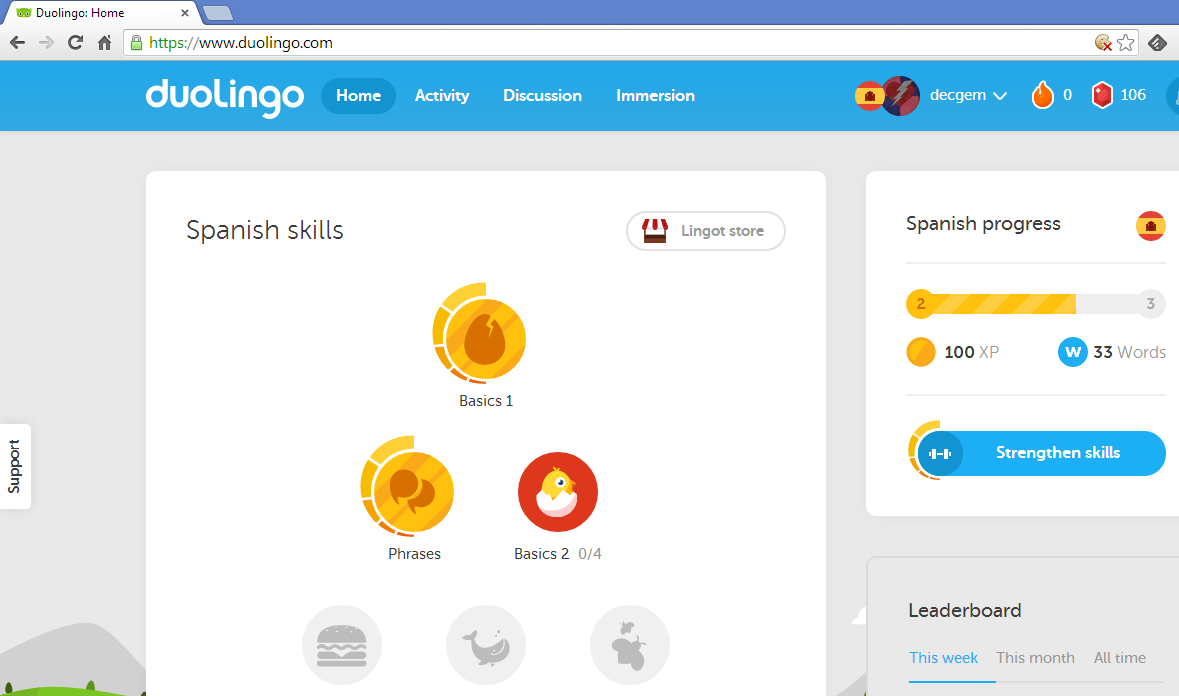
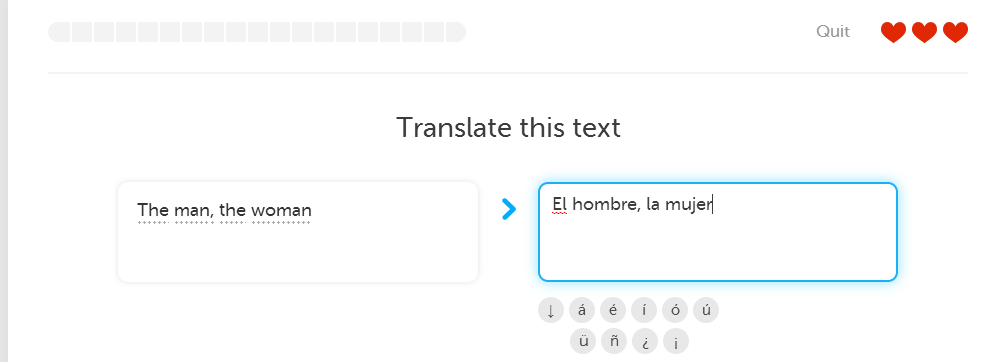
For this effort I’ve chosen Duolingo, with which I previously had a positive experience practicing Portuguese just for fun.  It’s a colorful site that offers an intuitive scaffold of each language to climb toward proficiency, breaking it down into digestible, thematic chunks--sometimes grammatically like pronouns, sometimes by subject matter like food.


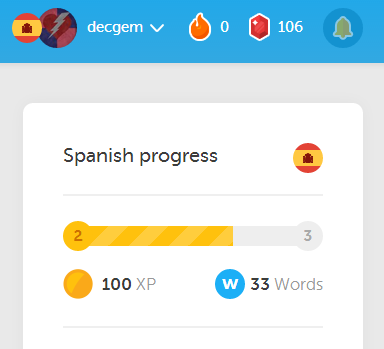
The experience is nicely gamified to grab and hold attention: you earn points for successful lessons completed and which you can compare with those of your friends, and you earn bonuses for streaks of days practiced.  During lessons, you have three hearts--make too many mistakes and lose all your hearts, and you have to restart in that area.  But success also earns you some web-currency, ‘lingots,’ which you can use to purchase bonuses and upgrades, like extra hearts.


One feature I didn’t grasp at first, but which is actually really helpful, is aimed at combating recall decay.  When you complete a lesson, you have four full bars in the skill it covers--a happy little fully-charged feeling.  But as time goes by, you lose bars, and you have to go back and practice that skill to build bars back up.  It’s a great visual cue to remind you to go back and really lock down that content, rather than washing your hands of it.


The goal of Duolingo is to crowdsource translations of web-based content.  The thought is that there are too many millions of gigabytes of content building up through such outlets as  BuzzFeed for it ever to be translated in-house for global access.  By teaching people some of the top world languages, Duolingo hopes to harness their new skill to fill that gap.  Every now and then a dialog box pops up saying “You can now translate x% of all listicles!  Why don’t you give it a try!”

Frankly, I’m dubious.  It’s a noble aim and I will certainly do my part if I feel like I know enough to contribute competently, but even after months of practicing Portuguese, I wasn’t confident tackling BuzzFeed translations.  Especially not given the slang-heavy nature of most Web writing--Duolingo focuses on official language, so I’m really not sure how successful I’ll ever be in this part of the operation.  But I applaud those who make it work.

If you’re in the mood to pick up a new language, need a crash-course for a new life situation, or want to brush up on an old favorite, Duolingo is a great option.  And did I mention it’s free?  Money talks (several languages).  And if you already have a background in a given language, you can test out of the basic lessons and dig right into the  pollo y manzanas (chicken and apples--as close as I can get to ‘meat and potatoes’ so far!).  Eventually I will branch out from Duolingo and enlist some Hispanophone friends to converse with me and share more advanced, library-specific vocabulary...but for now I have to get my conjugations down.


So that’s my first self-directed course of study in my own private spring semester.  Tune in soon when I let you in on my efforts exploring coding and gamification, and chime in with your thoughts and feelings in the comments!

Sunday, August 25, 2013

Westward Ho!

Welcome back to my blog, y’all!  I had a great time in the mountains the past couple weeks, exploring Denver and that playground of the rich, Aspen.  I also visited some relatively more rustic and rugged locales in and around Pitkin and Eagle counties, hiking, eating, and taking way too many low-quality pictures.


If I’m traveling, it means I’m visiting libraries, for my edification and for yours!  And I explored some great ones out in Colorado.  The three that I was able to spend time in felt like they had a lot in common: they provided clean, peaceful environments for research and study, a variety of innovative programs, and each seemed suspiciously like they had been built or remodeled in the past couple of decades.  I thought this especially interesting since the three libraries served different population sizes and types of communities: one was the vast Denver Central Library, the next the modest, rural Basalt Public Library, and the third the Pitkin County Library, a hub of posh Aspen itself.  To me this speaks of a unity of mission of libraries in the state as well as an encouraging unity of support from the community.  Granted, three libraries does not a thorough investigation of a state make, and all three are in the orbit of some of the most monied people in America (at least for part of the year), but I thought that the consistency of excellence across these three distinct libraries must be indicative of a supportive environment.


(My theories of a unified environment are further borne out by Colorado Libraries Collaborate, a statewide resource sharing initiative sparked by libraries volunteering to pool their materials for the good of the people of the Centennial State.  That’s my kind of ethos!)


I won’t bore you with the details of my trips through each library, but I did want to call out a few of the coolest features I noted!


Located just down the street from my hostel and at the confluence of downtown and a somewhat less affluent area, this central library seems perfectly situated to serve the needs of a big city’s diverse population.  The building itself, completed in the mid-90s, is beautiful, constructed in a style I have come to recognize as de rigueur in classy mountain design--stained hardwood, rustic touches, clean lines.  It’s a very inviting edifice.


The coolest thing about the long central entry hall is the automated conveyor belt book return.  So neat!  Thrill to the sight of librarians scurrying about behind glass like ants in a charming childhood memory.  Seriously, though, opening up this ‘behind the scenes’ business of the library is a great bit of outreach.


Off in one corner was another interesting touch: power check meters available for patrons to check out.  Perhaps not unexpected in a crunchy city like Denver, but I thought this was really cool.  Seems like the kind of thing a lot of well-intentioned people might think about getting around to doing someday, but never do it because--well, where do you start to figure out how to check your power usage?  The library takes the question away and hands you the tool to do it.  Fo’ free.


Obviously, me being me, I had to check out the graphic novel collection.  It was pretty sizable and seemed focused on adult, literary titles, including some I’d never encountered before.  They’re also arranged on a series upright racks with mostly outward-facing shelving, making browsing a breeze.  No chance here of that old problem of freezing in the face of an over-stuffed shelf full of wee little spines.  


I was probably most excited about visiting this little rural library, since it hosts one of my favorite innovative services--a seed library!


But first, again, the building itself is lovely.  Possibly the loveliest I’ve encountered, all earthy greens and browns and surrounded by bright mountain flowers that just invite you to roll around in them like an oxygen-starved puppy.


This library struck me as a true gathering-place and central community repository for a spread-out area, its bulletin boards overflowing with notices for events near and far.  And it’s just comfy, with big windows letting in plenty of mountain light over a fireplace-equipped sitting area.  One section of the library was given over as a ‘business center’ with staplers, paper cutters, and so forth, a feature that neither I nor my fellow librarian companion had ever seen before.  And in a sop to my Pagan heart, a Lunar phases poster was tacked to one wall!


The star of the show is the seed library, though, which ended up being a slightly unassuming-looking area right in the front of the building.  Unassuming, but brilliant and, by all accounts, effective.  For the uninitiated, a seed library is just what it sounds like: a way for folks to share seeds and grow their own food, “borrowing” the seeds from the library that they then “return” in the form of the seeds from their harvest.  The library here offers delicious-sounding seasonal veggies and some flowers, with one stated goal being the adaptation, from generation to generation, of these plants to the local environment.  And again, this is a service that might provide on-the-fence patrons with the means, and thus the excuse, to finally get started on a long-considered project.  Library as to-do list trimmer FTW!


What I liked about this one was the veritable explosion of adult and teen programming available.  All over the boards and their digital video screen were notices of upcoming events in the library and the community: adult story time, a tattoo talk, teen read-alikes.  They are all presented very professionally--someone on staff is good with design--and cover an interestingly broad range of topics.  Very nicely done.


The graphic novel section is much more super hero-y here, which I certainly enjoy, though the all-ages items are tucked away in the teen section.  I might make a different decision there, but perhaps space is a concern.


The extensive music collection downstairs offers not only popular and classical musical recordings, but a very impressive spread of music-related books.  Biographies on Brahms rub shoulders here with Beatles songbooks.  Aspen is, after all, the home of the Aspen Music School and Festival, an annual masterclass that brings upcoming talent together with some of the greatest names in contemporary classical performance, and a town where you can often find fresh-faced young musicians shredding away at their violins and cellos on street corners, giving you a taste of impromptu selections of Sibelius and classic rock and contemporary pop in between your pit-stops at Rocky Mountain Chocolates.  (Mmmm, chocolate-covered oreo…)  Appropriately enough, the library has a complete collection of Aspen Music Festival recordings available for your historical listening pleasure--though access is, reasonably enough, restricted.  (And, music students, please mind the signs posted and addressed to you on all major exits: return library materials before leaving for the summer!)


Thus ended my exploration of Colorado public libraries.  I’m quite impressed by what I’ve seen, and if the whole state is filled with such vital, responsive institutions, I’m jealous indeed of all you Coloradans out there--rivers of hail notwithstanding.  (What is up with that, anyway?)

Sunday, July 28, 2013

Opening Up a Can of Libraries on All the World's Problems

I’ve been thinking a lot about the world’s big problems lately.  Fracking poisoning our water supply, pesticide cocktails killing off the bees, climate change, privacy and the government’s reach (and the public’s inability to adequately gauge appropriate levels of either)--it’s all so overwhelming.  I believe that staying informed and voicing our opinions on these issues can help, but it’s a minor kind of help at best, a lot of the time.


So I like to go looking for domains in which the efforts of the little people can have outsized positive consequences. Luckily, my own lovely librarianship is one where small-scale and grassroots efforts are doing incredible things for communities, the country and the world by bridging access gaps, addressing special needs, promoting literacy and so much more.  Here are just a few of my favorite examples of such efforts--I hope they brighten your occasional gloomy outlook!


  • The Volunteer Librarian Brigade: This radical, grassroots effort based in New York City brings the ‘roving librarian’ concept to a whole new, and necessary, level.  It doesn’t occur to many people out on the street to go to a library to get help, so these folks bring the library to the streets.  Professional librarians train volunteers in the basics of reference and research work, then they all head out to make a difference.  If you’re in the New York area, consider joining up!
  • Librarians Build Communities: In the same wheelhouse, this is a web-based service pairing librarians (and their skills) with communities and organizations in need.  It’s another kind of roving, this time focused on the things librarians do that are not necessarily book-oriented.  Why haven’t we been doing this for decades?
  • The Internet Public Library: Another go-where-they-are entry, this website brings reference services to the masses over the non-threatening medium of the Internet--and as a bonus, it provides real-world experience for LIS students, which is always great (and somewhat rare!).  Search their site or submit a query, and dedicated (or dictated) volunteers will soon have a detailed answer for you.  It’s hosted by Drexel University’s College of Information Science and Technology, so you can trust their quality-control to have some cred.
  • Little Free Library: As far as i’m concerned, this one is almost venerable at this point--not because of age, but because of the impact it’s made during its existence.  So simple, so good.  The mini libraries built with the support of the folks running this show are cute, artsy, and/or surreal in form, and they’re popping up all over--taking ‘take a book, leave a book’ up a level or twelve.
  • ALA Think Tank: Social media drives this community that underscores the quirky, funny, and unabashedly rough-hewn side of librarianship.  This group is an incubator for great ideas and great librarians.
  • LibraryReads: This is a brand-new book recommendation initiative.  It’s extremely open--any employed public librarian will be able to contribute recommendations and reviews once the service launches in the fall.  Sure, it’s a major undertaking with a snazzy website and everything, but by its nature this kind of reader’s advisory has a very personal touch.  And of course, pulling book recommendation out of the hands of the publishers’ echo chamber and the rarefied ivory tower of the critics can only be a good thing for readers!
  • Libraries Changed My Life tumblr: A great public outreach tool.  What better way to pump up the public than by asking them to share their own beautiful bibliotecky memories?  The posts so far are funny, sweet and throat-lump inducing.  And it’s a tumblr blog, which is just so full of win right now, to use the argot of the day.
  • Queer For Books: An individual effort that fills a serious gap, this evolved from an LIS student project into what is, in my ever so highly qualified opinion, the go-to resource for LGBTQ resources and knowledge for the information professional.  LGBTQ patrons tend to languish on the underserved side of public institutions, due to the population’s innate tendency toward invisibility and a lack of awareness of those knowledge gaps on the part of non-LGBTQ professionals.  This fills those gaps most admirably for librarians.  Big kudos to my web-friend Sami Gardner for building this.  If my readers do nothing else with my blog, please put this site in your toolbox!
  • The librarian who banned a book: I love this guy and what he did and why he did it.  He made a stir over what is often an ossified  issue that is often condemned by rote, or worse, ignored entirely.  Of course we all mostly oppose book banning, but until it happens in our community, we are rarely moved to agitate for the right of freedom of expression and inquiry.  If that sounds gloomy for this hope-oriented post, take a page from DiMarco and...ban a book at your library?  Never thought I’d be saying that...
  • Librarians LOUD: Okay, so this might be a little bit of tooting my own horn. I was part of a group of library students at the University at Buffalo who staged this three-day event last year, which included a game-filled festival, lively panels, an information booth, visible read-outs around campus, and a rally outside the university president’s office building.  The goal?  To raise awareness that we exist, that we have voices, that yes, you need a  master’s degree to be a librarian.  We hoped to get students and faculty talking about those noisy, kooky kids with the silly signs out on the pavement--and we succeeded.  Now we’re planning Librarians LOUD 2--Louder and Librarian-er! (That’s not what we’re calling it.)  This year, we’re hoping to get other schools and libraries involved, too.  Wanna be loud with us?  Email me at andalex34@gmail.com!


The point of all of these examples is that everything librarians touch turns to gold.  Okay, maybe not gold, but we do a lot of things to make a lot of things better--our patrons’ lives, their communities, and our own profession.  Radical, individual, and/or grassroots expressions of the knowledge, power and importance of librarianship help move society forward.

That makes me feel better.