Monday, April 7, 2014

Spoiler Alert: You're a Jerk

Warning: This post contains spoilers for the first three seasons of Game of Thrones and some pre-2014 Marvel Cinematic Universe films.  It does NOT contain spoilers for GoT s4, Captain America: The Winter Soldier, or any future MCU films.


I’ve had a couple unfortunate incidents relating to spoilers in the past week, which is a big peeve of mine.  And, as it’s Game of Thrones season, as well as new Marvel movie season--basically the two things I care about most in TEH WORLD--it feels especially like I’m traipsing through a social media minefield.


But what bugged me this week weren’t the spoilers themselves--both were relatively mild--but the attitudes that seem to come with them.


The Shape of Things to Come


The first incident came about on my go-to source for Game of Thrones news, winteriscoming.net, which I’ve been casing all the more regularly as the fourth season has approached.  I know, I know: how can I complain about spoilers when I frequent fan news sites?  Well, I’ve gotten pretty good at reading the kinds of things that, as a previous fan of the books, I’m comfortable knowing about the show, and avoiding the posts that give away things I don’t want spoiled.  We all have to set up these buffer zones of desired ignorance these days.  For me, casting news and crew interviews and things like that are okay because they tend only to reveal, sometimes indirectly, the inclusion of elements of the story I knew had to show up on the show sooner or later.  The things that I avoid are those that threaten to reveal particulars of adaptation and the shape of the season as a whole--which I think makes sense; since I know the story from the books, one of the vestiges of viewerly surprise for me is in the pacing of the season, how the creators choose to dole out incidents, and what level of significance they assign them.

The major info to avoid in that regard, then, are the episode titles, which usually start trickling into the press a few weeks before a season premiers.


So, I go to read a post featuring an interview with a cast member, and what do I get in the very first sentence, before I have time to stop myself, but the title of a late-season episode? And it’s one that clearly betrays the episode’s focus on a particular character--and it’s not, like, “The Tyrion Episode” or something equally expected, but something a bit subtler.  Sad pandas for Alex!


So, annoyed, I post a little comment (prefaced with “Bah”--oh, the temerity!) suggesting that the site runners, who are, after all, not amateurs anymore, might consider being more considerate of those of us who consider episode titles to be overly spoilerly.


Cue the arrogantly snotty reply from the site’s resident unnecessarily aggressive mod (hi, OursIsTheFury!  You picked an apt handle), basically questioning my intelligence for reading pre-season news at all and my manhood (ha, I have to laugh) for being so sensitive.


I recognize the dilemma here.  I can’t expect my standard of appropriate spoiler policies to be in effect everywhere I browse; the onus is on me to be a careful reader.  But the outright dismissal of this as a category of sensitive material left me even angrier than before, implying that it won’t matter how careful I am--on this site, at least, episode titles will be fair game, no one cares about my objection, and I won’t have a way to avoid them unless I avoid the site altogether.  


That won’t do, so I’ll suck it up, and if I learn too much in advance, I’ll put on my big boy pants and try not to let it ruin my enjoyment of things.


But man, that guy’s attitude bothered me.  He didn’t come in contritely and patiently explain that their policy doesn’t cover my concern.  He didn’t express understanding of my feelings on the matter.  He went right for the diminishment and the dismissal.


Are we not your customers, sir?  Do we not click your links and share your posts and provide you with the status you now enjoy?  Can you not, then, treat my concern with appropriate tact, with an understanding that spoiler frontiers are not fixed, and that you should at least be nice to people who feel like you’ve messed something up for them?  
I can understand, definitely, how people might see my personal spoiler comfort zone as really restrictive, but it is my right to define my limits as I see fit and to at least ask you to respect them.  


But even if you’re scoffing at my personal spoiler limit, I ask you to consider this:  It’s one thing for book readers to expect the Red Wedding as it approaches on the show.  We knew it was coming and expected where to find it regardless of whether we knew episode titles.  The show had established a pattern it was not likely to break in this instance.  A momentous event like that one takes on Shakespearean qualities--it doesn’t matter that you know the end.  The impact will be the same--heightened, even, by the sense of expectation.


The same can’t be said of the numerous details, less-epochal shocking events, and hints of character arcs whose coordinates can be revealed by seeing the episode titles early.  Thus, I don’t think it’s unreasonable for some fans to consider titles to be spoiler territory, and to ask that that info be guarded behind spoiler warnings.


It’s especially important for readers of the series like me to conserve what surprises we may, since many of the broad strokes of a given season are known to us.  Yes, a large measure of what remains to thrill us is how those events are adapted--the visual elements, the pacing, the dialogue, and so much more.  But a part of it is also the order that the adapters place them in, and the importance they ascribe to events, both of which can be revealed through episode titles.


Texture and Grace Notes


I avoid casting news on minor characters in Marvel Cinematic Universe movies (read: one-off ‘events’ farther from the adapted source material than Game of Thrones is) for the same reason I tend to avoid episode titles before any show’s release: these characters are small details that inform the texture of a work in the motion picture entertainment medium.  Additionally, in the MCU in particular, they provide a great amount of fun as the studio mines forty-plus years’ worth of bit villains and supporting cast members to round out their world-building.


So I was both heartened (initially) and annoyed (just after) when a “spoiler-free” review of Captain America: The Winter Soldier offhandedly mentioned the appearance of a small, silly classic foe whom I am inordinately fond of.


Look, of course it’s no surprise that TWS would be the Cap, Black Widow and Falcon show--that’s fine, there are your marquis characters right there.  But the surprise of that little “boss level” villain would have given me more of a thrill if I had discovered it on viewing the movie, not in an article beforehand.  I know because I have been pleasantly surprised by previous MCU movies (Kurse!), and even by a better-kept-secret about the current film, which I certainly won’t spoil here.  (I might consider even this hint too spoilery in some cases, but I have to draw the line at some level of insanity.)


These movies also contain what I think of as “grace notes”--entirely unnecessary elements that nonetheless contribute to fans’ overall enjoyment, and often set up future movies--reminding us that we are in the midst of the biggest ongoing film story ever attempted.  Nothing epitomizes that wondrous quality of every Marvel movie better than their now-famous “post-credits” scenes.  Here’s a hint about those in relation to your social media etiquette, folks:


DON’T SAY ANYTHING ABOUT THEM.  Don’t even HINT.  Don’t say one word about the substance of these scenes.  That’s doubly true for those of you who don’t know the source material and don’t know, then, what single word might be a giveaway to a friend who has to wait til the end of the week to hit the theatre.  If you thought it was cool, you can say so; confusing, sure; funny, annoying, bad--any of those basic descriptors, have at them.  But avoid specifics, at the very least until after the opening weekend, and regardless, MARK SPOILERS.  And even saying “Oh, that wasn’t really a setup for any future movie,” as has sometimes been the case, is too much--because that deflates our anticipation for what may be coming in these scenes, and tempers our enjoyment of what may be meant to be humorous or cathartic.  BE SMART.


That’s just some friendly advice.  People will like you better.  Ruining stuff like this is like making a fart noise during a Chopin etude.  Just don’t do it.  Think about whether what you’re planning to say would have ruined things for you, and plan your divulgence appropriately.  (For that matter, all those smug jerks who were talking about “something called the Red Wedding, wink-wink,” you’re guilty of the same kind of thing.  “Gee,” thought no show-viewer ever, “I have no idea what that might refer to and will thus not ascribe any special importance to the much-mentioned wedding coming up in the traditionally-climactic ninth episode.” HINTS AND ELBOW-RIBBING AND COY REMARKS ARE SPOILERS.)


A Few More Kids I Have to Get Off My Lawn


And what’s with saying “spoiler alert” as a mid-sentence parenthetical and then continuing to the spoiler with absolutely no space in between?  My brain doesn’t stop on a dime.  The momentum of reading has carried me forward into more than one patch of spoilage.  ALWAYS SPACE YOUR SPOILERS.


For that matter, what’s the statute of limitations on spoilers, anyway?  The Red Wedding is spoken about pretty openly these days, but I would contend that it’s too soon to dispense with warnings for the few people who have not seen it (remember, I gave an alert at the top of this post!).  Heck, if it were up to me, we’d still be tiptoeing around the first season’s big shockers--you know who you are.


Most of the universe seems to disagree.


I also got into an argument with a friend about a comic book event from decades past that may or may not be due to make a film appearance in the next year or so; I said that all discussion of such an event in relation to the film should be treated carefully, while he maintained that it happened so long ago it is pretty much common knowledge.  But at least 50% of the point of all these film adaptations is to reach audiences unfamiliar with the brilliant source material, who wouldn’t know Hank Pym from Scott Lang, the Nova Corps from the Green Lantern Corps, or a Hobgoblin from a Green Goblin.  They should have no idea of what’s to come--not a hint--and they should be shielded from foreknowledge in the interest of their maximum enjoyment.  Just like we all got to enjoy stuff for the first time, hopefully.


For the record, I’m not saying that discussion of these kinds of plot points should be shut down entirely--I merely contend that we should remain liberal with our use of spoiler warnings when getting into sensitive material.


I feel like this is all an important series of considerations in the modern media consuming era (a topic I also talk about here, from a different angle)--a matter of artistic justice, as it were.  The speed at which we consume, the eagerness with which we approach our material, and the nature of communication in the social media world mean we have to develop a new sensibility when it comes to safeguarding our enjoyment of our favorite media--as well as the enjoyment that our friends seek.  No longer is the water cooler the only front in spoiler wars, and the stories on offer tend to have higher stakes, and thus more emotional resonance, than when America’s main concern was whatever Ross and Rachel were up to the night before.  We all cared so much about that--just a couple of doofy New Yorkers’ romantic life--how much worse is it to ruin the latest life-and-death, bated-breath developments with Tyrion, Dany, Cap and Tony?

Consider yourself warned.


Sunday, March 30, 2014

Hiya Hiya Hiya: I'm back; quarterly media review

I’m back from a long trip, and have taken a week to dig myself out from under my piles of correspondence, tv, and dirty laundry.  I wanted to swing back into action with something a little more meaty, but, well, wishes and fishes.  Instead, as I so enjoyed my year-end review of media back in December, I thought I would inaugurate the practice as a quarterly thing.  Writing this has left me plenty of time to finish my laundry for real (but I still haven’t).

Rest assured that I have plenty of topics in mind for the coming weeks--Snowden and the NSA!  “Information scientists”!  Being civil in the course of criticism!  What’s a guy gotta write to go viral around here?  If none of that works I’ll have to pretend I’m an adorable moppet doing a social media experiment, and nobody wants that.

Books

Words of Radiance by Brandon Sanderson--book 2 of “The Stormlight Archive”

I feel about Brandon Sanderson as I do about Patrick Rothfuss, but with less venom.  I think both are weak writers who get way more acclaim from the fandom than they deserve, and I don’t always understand why, except that they offer certain surface-level satisfactions to fantasy fans. In Sanderson’s case, it’s uber-clever magic paired with eye-bleeding action.  In this, the second volume, of his great epic, the self-indulgence afforded by all that acclaim continues on into bloat.   

What’s more, Sanderson gives the impression of never having really lived.  As a result, he replaces any human sensibility in his work with an approximation of the adrenaline rush you get from the last level of your favorite video game.  He’s often praised for his cinematic writing, and I would agree, with the caveat that he fulfills only the most shallow definition of the term: he provides motion and spectacle with none of the visualized heart that good filmmakers perfected in the nineteen-aughts.  Plus, he continues to double down on humor in his writing that just...needs to stop.

So that’s more of my review of Sanderson than of this book, but I think it fits.

Dune by Frank Herbert

I hesitated to read this sci-fi classic for years; the genre is not my favorite, for one, but I also feared its space opera themes would fly over my head.  (Ah, pride!)  Well, it’s definitely a challenging read, but it’s also an extremely rewarding one, as well as just being beautifully written and thrilling to experience.  You’ll wonder why modern Americans can’t think about the ecological future of the planet as cogently as the Fremen do about Arrakis.  Now, I’m pleased to have finally rounded out my exploratory tastes of sci-fi classics--the others being Foundation and Hitchhiker’s Guide to the Galaxy--and look forward to continuing with the Dune series and beyond.

One Summer: America, 1927 by Bill Bryson

A rollicking, romping, compulsively readable look at a particular moment in American history, one that aptly reminds us how interrelated seemingly distant happenings can be--in this case, flight, baseball, natural disasters, and more.  It makes me wish Bryson would similarly treat every season of every year in world history, to tease out the fascinating connections between events.  What a project that would be.  For now, it’s enough to soak up this volume, and enjoy the sketches provided of Lindbergh, Ruth, Hoover and others--by turns hilarious, enlightening, and disturbing.  (Try not to get choked up at Calvin Coolidge’s account of his early loss.)

TV

True Detective

Most everything I watch is still in the thick of things right now, but this HBO series provided a compact, muscular character study of two broken men.  Now, I wasn’t too dense to notice the meta-narrative going on here, with the detectives’ exploits framed by their own sometimes guarded (to say the least) reminiscences in a contemporary police interview.  But, to be honest, I was too enthralled by Harrelson and McConaughey's bravura performances to worry too much about that, as well too busy keeping my eyes peeled for Lovecrafty references.  But the show rewards deep thinking and subsequent rewatches, which I intend to undertake soon.  And that opening credits scene is worth the price of admission all on its own.

Movies

I haven’t seen a one yet this year!  That’ll change with the next installment in the Marvel Cinematic Universe next week, though--Captain America: The Winter Soldier.  I’ll report back at some point.

Games

Dune

Here’s a weird fluke: I played the board game version of a famous novel before reading it.  Only barely, in this case, but still.  My lack of skill with this 70s cult classic (and rather early example of the high-concept board game trend) ensured a speedy defeat in only three or so rounds, but from what I saw of the game--its network of competing factions, its sandstorm and sandworm mechanics, and its built-in capacity for betrayal--whet my appetite for more playing and more reading.

Puerto Rico

Classic.  Just ignore the optics of importing little brown meeple to work your estates.  (Hey, points for historical accuracy, I guess?)  This game was interesting in that players don’t seem to be competing with each other within the framework of the same representation of the island colony, but rather across separate versions of Puerto Rico, each little ‘god’ vying to make his or her version the most optimized.  But then you work with the same shipping mechanic, so maybe not.  It’s a little garbled that way, but it’s a lot of fun.

Masquerade

I so enjoyed Citadels, the previous game by this designer, and Masquerade did not disappoint as a follow-up. This game has the remarkable mechanic of hidden identities--even from yourself.  Each turn consists of three basic actions--you can either peek at your own face-down character card to ascertain your own identity, declare yourself to be a certain character to claim that character’s special ability, or--fun!--blind-swap your card with another player’s, ensuring that you can rarely be sure who you or your opponents are.  If you opt for choice 2, though--”I am the bishop!” for example--one or more of your opponents can chime in to challenge you--”No, I’m the bishop!”  Then you check, and whoever was right (if anyone) gets to use the power, and whoever was wrong has to give up some coin.  I wouldn’t delve so deeply into the minutiae of these simple-enough rules, except that I think they’re delicious.  It was a great fun time, and it’s the kind of game that stays competitive throughout.

Bang

Another hidden-identity game (only this time you get to know who you are, at least).  I liked this one, especially because it takes a genre I don’t usually care about--wild west--and got me invested.  Before playing, I fell into the trap of thinking that mechanics for a rusty, old-timey genre would be equally dated-feeling, but Bang straddles the line between feeling thematically appropriate and happily universal.  The sheriff is the only players whose identity begins open, and the first few rounds are concerned with ferreting out who his deputies are and who the outlaws are (and don’t forget about that pesky renegade!), with each side pursuing its own victory conditions.  The scads of cards that modify your weaponry and range, heal your wounds and dodge fire lead to action-packed rounds.  Friends take hits and justice hangs in the the balance.  It also comes in a giant bullet-shaped container, so it’s really more fun that you can shake a cactus at.

Sunday, February 16, 2014

The Learning Curve: Adventures in Self-Directed Education

Back when I started this blog, I promised several recurring features that I haven’t always delivered on.  (I like to think that if you take the long view, all of my promises will be kept...it’s all a work in progress!)

One of those features was discussion of self-directed continuing education, with my own experiences with setting up curricula for myself as the model.  Of course, the main reason you haven’t seen much of that is because I haven’t done a great job creating and sticking to my own curricula.  Well, January started a new semester, and I’ve been much more successful so far.  Various web-based options are making it easier to keep up one’s education outside of the traditional bounds of the classroom, and I’m interested to hear from my readers about their own experiences or with commentary on my choices.

First off, I decided that continuing library/info studies education doesn’t necessarily have to include the stuff you might expect to find in your official program--on the contrary, there are lots of subjects that are of immediate benefit to the librarian but which don’t fit into our 2-ish years of training.  For me, top on that list is Spanish.

I’m interested in working in large urban public libraries, and nearly every job posting I’ve responded to has listed proficiency in Spanish as a preferred qualification, if not an outright requirement.  Well, this guy made the very positive, yet not so demographically savvy, decision to study French starting in middle school, going on to major in the language in college.  While I very much enjoyed learning to read and discuss Hugo and Sartre in their original tongue, it hasn’t lended itself to employers snapping me up.

Spanish, I recognize, is extremely valuable to know in the American workforce today.  It’s the most-spoken non-English language in American homes, and overall there are 69 million hispanophones in the US.  While a great many of them also speak English fluently or very well, there’s a sizable number who do not--and besides, sometimes it’s more comfortable for people to conduct business in their native language, no matter how well they speak another.  

In the little community public library where I volunteer, a good proportion of the patrons I encounter every day are Spanish-speakers.  I decided it was time I had the ability to at least offer the option of communicating in these folks’ first language.  While it will be many years before I’m able to do so in a way that won’t make them cringe at my vocabulary and accent, I can at least get the process started with increasingly useful, rigorous and affordable online language-learning options.  

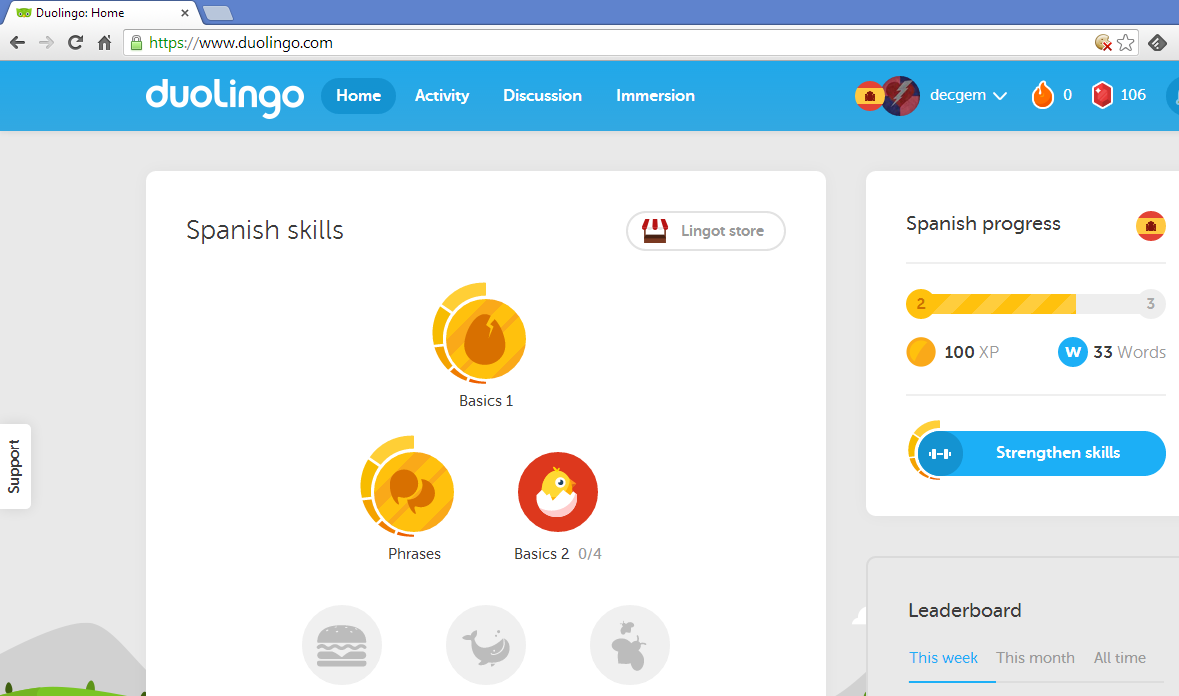
For this effort I’ve chosen Duolingo, with which I previously had a positive experience practicing Portuguese just for fun.  It’s a colorful site that offers an intuitive scaffold of each language to climb toward proficiency, breaking it down into digestible, thematic chunks--sometimes grammatically like pronouns, sometimes by subject matter like food.


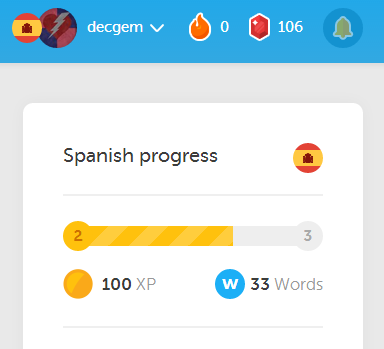
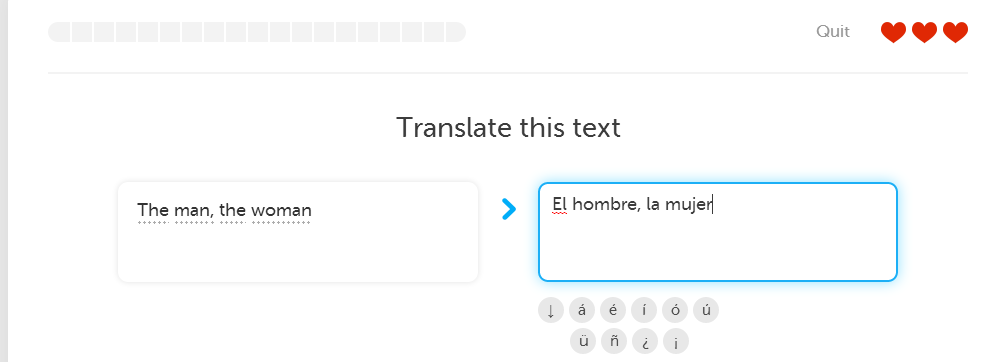
The experience is nicely gamified to grab and hold attention: you earn points for successful lessons completed and which you can compare with those of your friends, and you earn bonuses for streaks of days practiced.  During lessons, you have three hearts--make too many mistakes and lose all your hearts, and you have to restart in that area.  But success also earns you some web-currency, ‘lingots,’ which you can use to purchase bonuses and upgrades, like extra hearts.


One feature I didn’t grasp at first, but which is actually really helpful, is aimed at combating recall decay.  When you complete a lesson, you have four full bars in the skill it covers--a happy little fully-charged feeling.  But as time goes by, you lose bars, and you have to go back and practice that skill to build bars back up.  It’s a great visual cue to remind you to go back and really lock down that content, rather than washing your hands of it.


The goal of Duolingo is to crowdsource translations of web-based content.  The thought is that there are too many millions of gigabytes of content building up through such outlets as  BuzzFeed for it ever to be translated in-house for global access.  By teaching people some of the top world languages, Duolingo hopes to harness their new skill to fill that gap.  Every now and then a dialog box pops up saying “You can now translate x% of all listicles!  Why don’t you give it a try!”

Frankly, I’m dubious.  It’s a noble aim and I will certainly do my part if I feel like I know enough to contribute competently, but even after months of practicing Portuguese, I wasn’t confident tackling BuzzFeed translations.  Especially not given the slang-heavy nature of most Web writing--Duolingo focuses on official language, so I’m really not sure how successful I’ll ever be in this part of the operation.  But I applaud those who make it work.

If you’re in the mood to pick up a new language, need a crash-course for a new life situation, or want to brush up on an old favorite, Duolingo is a great option.  And did I mention it’s free?  Money talks (several languages).  And if you already have a background in a given language, you can test out of the basic lessons and dig right into the  pollo y manzanas (chicken and apples--as close as I can get to ‘meat and potatoes’ so far!).  Eventually I will branch out from Duolingo and enlist some Hispanophone friends to converse with me and share more advanced, library-specific vocabulary...but for now I have to get my conjugations down.


So that’s my first self-directed course of study in my own private spring semester.  Tune in soon when I let you in on my efforts exploring coding and gamification, and chime in with your thoughts and feelings in the comments!

Sunday, February 9, 2014

Media Binges: The Good, the Bad, and the Library

We live in an era of a new media consumption model--the binge.  

We stream whole seasons in a day and knock off DVD box sets in a week.  DVRs and On-Demand services allow us to enjoy marathons of our current programming without (as many) ads or those pesky week-long waits between plot points.  Spotify and iTunes playlists deliver our music to us in a neverending cycle.  

And librarians are particularly responsible for making even books into objects of mass consumption--what else would you call our insistence that we cram as much reading as physically possible into each year? It’s bingeing at a slightly slower frame rate.

So what to make of this burgeoning trend?  Is this a positive development, a negative one, or in between?  And what role should libraries play in supporting or combating it?

I, for one, am excited about libraries’ ability to promote media-gulping.  For one thing, since it’s what people are doing anyway, it’s great that libraries are already equipped to mesh with their behavior; many of us have got respectable runs of popular TV shows on DVD, ready for plowing through, and we already do a brisk business in DVD lending.  Why pay for Netflix?  (And if you want Netflix too, maybe your local library can help fill some of its frustrating online gaps.)

Beyond that, though, I think that media bingeing is actually a positive development, and librarians are in place to mainstream it and its benefits.  My experience with reading, in particular, shows me that the longer a process is strung out, the more comprehension and command of detail suffers.

In an environment where even the most accessible of TV dramas operates on a serialized basis, and where your TV sitcom favorites undergo actual character growth and change across a season, watching TV is more like reading a novel than ever.  That’s a good thing, but it doesn’t really work with the traditional broadcast television model.

It’s been opined that Game of Thrones functions better as a season-by-season unit while some individual episodes suffer in isolation. I’ll go out on a limb and suggest the same applies for Breaking Bad, Homeland, Downton Abbey...heck, schlocky Revenge and Scandal are often difficult to keep track of from week to week.

So maybe for some people, it’s optimal to wait for the end of the season or for the DVD release, either for the sake of aesthetic appreciation or for personal viewer comprehension.  And again, who has those DVDs ready for free (and who is hot on the trail of various streaming access options)?  Don’t make me spell it out for you!

So, bingeing is good and libraries promote it--but sensible consumption is a desirable outcome as well.

Sitting in your basement watching all of Breaking Bad is a closed circuit activity unless you internalize lessons learned, share opinions, and rejoin the community with new things to say and new perspectives to offer.  Happily, the Internet provides opportunities for this kind of interaction in droves, and many consumers avail themselves of such things.  But a lot do not.

Librarians have a responsibility to perform, model and instill the habits of conscientious media consumption.  We need to write and post reviews, in our public and private lives both.  We need to call out positive and negative examples of media citizenship--applaud diversity and inclusivity; decry stigma and exclusion.  We must encourage our patrons to be canny consumers--introduce them to Goodreads and Getglue and IMDB message boards.  Inspire them to become critics in their own lives.  

If you want to get really crazy, promote the idea of tracking amounts and types of media consumption--with the goal of demonstrating growth in terms of amounts digested, the complexity of ideas encountered, and the types of genres and media in which fluency has been achieved.  

Why promote all of this?  Because watching TV and movies, reading books, and listening to music doesn’t have to be a totally solipsistic, zero-sum endeavor.  Exposure to ideas and events should change us, and we should be able to recognize how it’s changing us--the better to place ourselves in relation to the world around us.

(Slightly off my desired track, but important to note: the library is a good place to be a media consumer without resorting to thievery  Librarians need to make sure potential patrons know about the damage pirating material does, and not just in a self-interested “Don’t sue me, brah!” way.  Pump up the library as a legit conduit in the media consumption pipeline, much safer and happier for everyone than torrents or Russian link aggregators.)

And at the end of the day, even if we can’t be THE player in binge media consumption, libraries can act as the great leveler--as we so often have.  We can be the solid option for all those who can’t choose to own seven seasons of Lost.  As always, it comes down to social justice, and equal access to entertainment is no less important an issue as access to research materials.

(Truly, say otherwise and I’ll fight you.  Art is the way we know ourselves.)

I’m genuinely amped about librarians’ role in promoting this paradigm, and I hope I’ve been somewhat convincing on the matter.  My fear is that some self-important members of the new crop of information professionals will decide that access to binge-worthy materials isn’t “critical” enough to dedicate resources to.  I hope many will join me in talking up the import of this stuff as librarianship continues to evolve.